
by Team Avista
Share
by Team Avista
Share

For years, B2B marketing has relied on a familiar formula: generate as many leads as possible, nurture them through a funnel, and hope the right prospects convert.
However, as buying cycles grow more complex and decision-making shifts from individuals to committees, that model is showing its limits. Marketing teams are seeing that throwing hundreds of darts in the hopes that a few stick is not a viable plan.
As a result, account-based marketing (ABM) is becoming a popular strategy for B2B marketing. The result is a more targeted approach to growth, one that many B2B organizations now consider essential.
What Account-Based Marketing Actually Means
Account-based marketing focuses marketing and sales efforts on a defined set of target accounts rather than a broad audience.
Teams begin by identifying organizations that closely match their ideal customer profile. From there, they create tailored campaigns designed to engage the specific stakeholders involved in the purchasing decision. Rather than marketing to thousands of anonymous leads, ABM centers on building relationships with current customers, which generates credibility among their peers and results in quality leads.
Modern marketing platforms have made this approach easier to execute. Tools such as HubSpot, Demandbase, and ZoomInfo have empowered ABM teams to identify target accounts, monitor buying signals, and coordinate engagement across sales and marketing channels. This level of coordination empowers organizations by helping them move beyond fragmented campaigns towards a unified revenue strategy.
Why ABM Adoption Is Accelerating
The rise of ABM reflects broader changes in how B2B purchases happen. Today, most enterprise purchases involve multiple stakeholders across departments. Marketing to a single lead rarely captures the complexity of that decision-making process. At the same time, buyers conduct much of their research independently before speaking with vendors. This means marketing teams need to engage organizations earlier and more strategically.
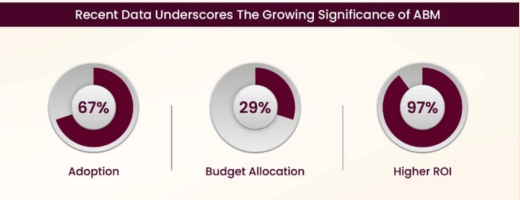
The shift toward ABM is already taking hold.
- Research shows that 71% of B2B marketers now use account-based marketing programs.
- Multiple industry studies have shown that between 76% and 87% of marketers report higher ROI from ABM compared with traditional marketing strategies.
- Companies implementing ABM often see conversion rates improve by around 25%
The ABM data supports what marketers are seeing on the ground. As a result, ABM is becoming a core component of B2B marketing strategies.
Rethinking the Traditional Marketing Funnel
The traditional funnel assumes that marketing generates a large number of leads and gradually narrows them into qualified opportunities. ABM flips that model.
Instead of starting wide and narrowing later, organizations begin by identifying high-value accounts and focusing their media efforts on the customer’s story. Successful teams increasingly treat the ABM sales funnel as an account-focused journey rather than a lead-focused pipeline. This approach changes how marketing operates.
- Target Accounts Come First – ABM begins with defining an ideal customer profile and identifying organizations that fit it. Marketing and sales teams generate a prioritized list of accounts that become the focus of outreach.
- Engagement Becomes More Personalized – Because the audience is smaller and more defined, messaging can be tailored to the specific needs of each account, industry, or buyer role.
- Sales and Marketing Operate as One Team – ABM requires tight coordination between marketing campaigns and sales outreach. Rather than working in separate pipelines, both teams focus on advancing the same accounts.
- Success Is Measured in Revenue, Not Leads – ABM shifts metrics so they account for engagement, pipeline influence, and deal progression. This alignment helps organizations because it concentrates on resources with the greatest impact.
Technology Is Enabling Scalable ABM
One reason ABM has gained traction is that today’s technology makes it scalable.
Platforms designed for account-based marketing help organizations identify high-value accounts, track engagement signals, and deliver coordinated campaigns across channels. When in action, the right ABM platform helps teams identify companies showing early buying intent, segment accounts by industry, technology stack, or behavior, deliver personalized messaging across all channels, and provide sales teams with insight into account activity.
One example, HubSpot, continues to improve its ABM capabilities, allowing teams to unify account data and engagement insights in a single system, helping sales and marketing coordinate more effectively. The result is a marketing engine that is built around relationships, not just numbers.
What ABM Means for Modern B2B Marketing
Account-based marketing is not replacing traditional demand generation entirely. Instead, it is redefining how organizations prioritize their efforts. For many companies, the future of marketing lies in striking a balance between broad awareness campaigns and targeted engagement strategies for high-value accounts.
ABM provides a framework for doing exactly that.
By aligning marketing and sales around shared account priorities, organizations can focus on the prospects most likely to become long-term customers. As B2B buying processes continue to evolve, that kind of focus may become one of the most valuable advantages a marketing team can have.
If you are interested in starting or enhancing your ABM journey, our team at Avista would be happy to assist you. Reach out today to get started.
Related Posts:
STAY IN THE LOOP
Subscribe to our free newsletter.
Related Posts

Today, newsrooms are leaner, deadlines are tighter, and the pressure […]
-
For years, B2B marketing has relied on a familiar formula: […]

As the marketing landscape continues to waver in strategy and […]

As AI adoption accelerates, traditional Google SEO is rapidly losing […]